Propane Infrared Patio Heater Buying Guide
Pick a propane infrared patio heater by matching its radiant heat to where people sit, then by tank, clearance and wind needs. Buyers who want fast warmth in one spot do best with a radiant unit rather than a convection tower.
On this page (10 sections)
- What does "infrared" mean on a propane patio heater?
- How do you match heater output to your seating area?
- Where should a propane infrared patio heater sit?
- What fuel setup does a propane infrared patio heater need?
- How does wind change your heater choice?
- Do you need a tower, tabletop or pyramid heater?
- How do you judge build quality and safety features?
- How much does a propane heater cost to run?
- Propane or electric infrared: which fits your patio?
- Which propane infrared patio heater should you pick?
Pick a propane infrared patio heater by matching its radiant heat to where people sit, then by tank, clearance and wind needs. Buyers who want fast warmth in one spot do best with a radiant unit rather than a convection tower.
This guide walks through placement, fuel setup and heating needs in the order you'll face them when shopping. The goal is a heater that warms the people in your seating area, not just the air above it.
What does "infrared" mean on a propane patio heater?
Infrared means the heater warms people and surfaces with radiant energy instead of relying on warmed air. You feel heat directly on your skin and clothing, much as you feel sun on a cool day.
A propane infrared patio heater still burns propane in an open-air burner. The difference from a plain convection tower is where the heat goes.
Radiant heat travels in a straight line until it meets a person, a chair or a table, so the warmth lands where you aim it. This changes how you judge output.
A 46,000 BTU convection tower mostly heats rising air, while a radiant unit sends more of its energy toward the seating zone.
That's why two heaters with the same BTU number can feel quite different on a patio. Radiant heat also fades with distance.
A heater that feels strong at 4 feet may feel mild at 10 feet, so the placement of chairs matters as much as the output rating.
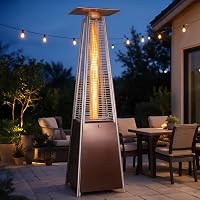
Some tower models pair a radiant burner with a reflective hood that spreads the warmth downward and outward. The Fire Sense Performance Series uses a double mantle heating grid over its burner.
That grid glows and releases radiant heat toward the patio, while the hood directs it down over the seating area.
The Amazon Basics 46,000 BTU model pairs its burner with a tall tower body and an adjustable temperature knob. Infrared warmth works best when people sit within its reach and face the unit.
If your seating is spread across a wide deck, one radiant tower will leave the outer chairs cold no matter how high you turn the knob.
Decide first whether your patio needs spot warmth or broad background heat, then compare models on radiant reach rather than BTU alone.
How do you match heater output to your seating area?
Match output to the seating zone you actually use, not the total square footage of the yard. A heater rated for a 9 foot radius covers a circle roughly 18 feet across when people sit within it.
The Amazon Basics model is rated at 46,000 BTUs with a 9 foot heating radius. That's enough for a compact dining set or a cluster of chairs around a fire table, provided people stay inside that circle.
Think in terms of seats, not acres. A four-seat patio table usually fits inside one tower's reach; a long outdoor kitchen or a wide deck with scattered chairs often needs two heaters placed at opposite ends.
Weather changes the math. Cold air, damp evenings and wind all pull heat away from people, so an exposed spot may need more output or a second unit.
A sheltered corner with a wall behind the seating holds warmth better.
Height matters too. A tower heater sends heat out from a burner mounted high on the body, so the warmth reaches seated people at an angle.
Lower tabletop or pyramid styles aim heat differently and suit close seating.
If your patio is large, plan two moderate heaters rather than one very powerful unit. Two sources spread warmth more evenly and let you run just one when only a couple of people sit outside.
Rule: buy for the seats you use on a typical evening, and add a second heater only when the seating circle is wider than one unit's rated radius.
Where should a propane infrared patio heater sit?
Place the heater outside the seating circle and on a level, non-flammable surface, with its front facing the people it warms. Distance from walls and furniture matters as much as the surface under it.
Keep the heater clear of combustible materials and follow the clearance distances in its user manual. Awnings, fabric umbrellas, wooden railings and potted plants all need space around the burner and hood.
Put the heater on a flat patio, deck or hard surface that stays stable. The Amazon Basics model has a water box in its base so you can weigh it down, and a chain to secure the propane tank.
Those details matter when a gust of wind hits a tall tower.
Keep the heater out of doorways and walkways. People moving past a hot burner is the most common avoidable risk on a busy patio, so set it where guests won't brush against it.
Face the burner toward the seating, not toward a wall. Radiant heat bounces poorly off nearby surfaces and can overheat them, and a wall behind the heater can trap exhaust.
Allow room for the tank at the base and for the hose to run without kinks. A heater that sits too close to the house also pushes warmth away from the chairs.
For more on clearances, startup and safe shutdown, read our guide on how to start a propane patio heater. It covers the checks that come before the first light of the season.
Rule: the heater goes where guests won't walk into it, facing the seats, on a stable base with the tank secured.
What fuel setup does a propane infrared patio heater need?
It needs a standard 20 lb liquid propane tank, a regulator and hose, and a safe place to store the tank when the heater is off. The Amazon Basics and Fire Sense tower models both run on a 20 lb LPG tank that isn't included.
A 20 lb tank is the familiar barbecue size. It's heavy enough to need a stable base and light enough to carry for a refill.
Most tower heaters are built around this size, so the tank sits inside the base or beside it.
Connect the regulator to the tank valve and check the connection for leaks before every season. Soapy water on the joint is the simple test; bubbles mean gas is escaping and the connection needs attention.
A tank gauge helps you plan. The DOZYANT Propane Tank Gauge Level Indicator Leak screws onto a QCC1/Type 1 connection and shows a color-coded dial: red for empty, yellow for low and green for sufficient.
It fits tanks from 5 lb to 40 lb.
Remember that the gauge reads pressure, not fuel volume. In hot weather the pressure rises and in cold weather it falls, so the same amount of propane can show a different level on the dial.
Treat it as a planning aid, not a precise fuel counter.
The Fire Sense model's consumption rate is about 10 hours on a full tank. A 46,000 BTU burner at full output draws fuel quickly, so a spare tank or a gauge saves a mid-evening refill run.
Store tanks upright, outdoors and away from heat. Close the valve when the heater is off, and never store a tank indoors or in a hot vehicle.
Rule: one 20 lb tank, a leak check at the start of the season and a gauge if you entertain often.
How does wind change your heater choice?
Wind is the main reason a heater feels weak on an exposed patio. Radiant heat is carried away by moving air, and a strong breeze can also push the flame away from the burner.
A wind-resistant base and a weighted water box help keep the tower upright. The Amazon Basics model includes both, which suits an open patio where gusts are common.
The Fire Sense model uses a weighted base for stability as well.
Placement is the bigger lever. A corner with a wall or hedge on two sides blocks much of the wind and keeps warmth around the seating.
An open lawn or a rooftop deck gives the heat nowhere to collect.
Shield the burner without blocking ventilation. A wind break at the base is fine; wrapping the burner or hood in fabric is not, because gas appliances need open air.
Seating distance matters more in wind. Move chairs closer to the heater on breezy nights, and expect the outer seats to feel cool even when the unit is running well.
If your patio is fully exposed and you sit out on windy winter evenings, plan on more than one heater or choose a model with a broad hood. A single tower rated for 46,000 BTUs spreads its warmth over a circle, and wind takes a share of it.
The tilt safety valve on both tower models shuts the burner off if the unit is lifted or tipped. That's a useful backup on a windy deck, though it doesn't replace a stable base.
Rule: in a windy spot, spend first on a sheltered seat position, then on extra heaters, not on a bigger single unit.
Do you need a tower, tabletop or pyramid heater?
Choose a tower heater for a full patio table, a tabletop model for close seating and a pyramid unit for looks and reach. Each shape changes how the radiant heat lands on people.
A tower heater stands about 7.5 feet tall. The Amazon Basics model measures 32.1 by 32.1 by 91.3 inches and weighs 16.78 kg.
The Fire Sense model stands 89 inches tall on an 18 inch base. That height sends warmth out above head level and down onto seated guests.
Tower, tabletop or pyramid?
Tabletop heaters are smaller and sit on the table or beside a chair. They warm a couple of people closely but cover less area and need table space.
They're handy on a balcony or a small patio where a tower would crowd the furniture.
Pyramid heaters have a wider, cone-shaped hood. The shape spreads radiant heat over a broader area, which suits a seating cluster where people face each other rather than one row.
A tower is the most common choice for a patio table because it fits beside the table without taking seating space, and its height keeps the burner away from children and pets better than a low unit.
Weigh the footprint before buying. A tower base takes up a corner of the patio, and the tank adds to that footprint.
Measure the spot and leave room to walk around it.
Rule: tower for a table and several seats, tabletop for a balcony for two, pyramid for a wide seating circle.
How do you judge build quality and safety features?
Look for powder-coated steel, a tip-over shutoff, a weighted base and a tank securing chain as the basics. These features separate a heater that lasts a few seasons from one that rusts or tips.
Both tower models here use powder-coated steel bodies. The Amazon Basics model has a Slate Gray finish and the Fire Sense model comes in Espresso.
A coating protects the steel from rain and patio moisture, though the finish still needs care over winter.
A tilt safety auto-shut off valve is standard on both. If the heater is lifted or knocked over, the valve stops the gas flow.
That's important on a deck with kids or pets around.
What extra features are worth paying for?
The Amazon Basics model adds a water box for weighing down the base and a wheel kit for moving it into place. The Fire Sense model has wheels for mobility and a weighted base for stability.
Wheels are useful if you move the heater between the patio and storage.
The Fire Sense unit also lists durable stainless steel burners and a double mantle heating grid. Stainless steel resists rust better around the burner, which is the part that takes the most heat and moisture.
Check the ignition type when comparing: the Amazon Basics model uses a one-touch ignition button, while the Fire Sense model uses an electronic ignition system. Both are simpler than a manual match light.
For a full look at the top-rated model in this category, read our Amazon Basics propane patio heater review. It covers the fit, features and trade-offs in detail.
Rule: never buy a patio heater without a tip-over shutoff, and choose coated steel over painted mild steel for a longer life outdoors.
How much does a propane heater cost to run?
Running cost depends on BTU output, run time and your local propane price, not on the heater's purchase price alone. A 46,000 BTU heater burns more fuel per hour than a smaller unit.
A full 20 lb tank holds roughly 4.7 gallons of propane. At a typical 46,000 BTU draw, the Fire Sense model's roughly 10 hour consumption rate gives you a working estimate for a full tank.
Check your local refill or exchange price to turn that into a cost per evening.
The adjustable knob on the Amazon Basics model lets you run below full output on milder nights. Lower output uses less fuel per hour and stretches the tank further.
That's a practical way to cut running cost without giving up the heater.
Wind and cold raise fuel use in practice. A heater working against a breeze burns more gas to keep the same seating area comfortable, so a sheltered spot costs less to run.
Propane prices vary widely by region and by refill method. A tank exchange usually costs more per gallon than a refill at a propane supplier, so check both options where you live.
Budget for a second tank if you entertain often. A spare full tank means the evening doesn't end when the first one runs dry, and a gauge tells you when to swap.
Rule: plan your propane spend around hours of use, not the sticker price, and run below full output on all but the coldest nights.
Propane or electric infrared: which fits your patio?
Choose propane when you need strong radiant heat away from an outlet and electric when the heater sits close to power. Propane towers deliver more output per unit than plug-in models and don't need a cord.
Propane suits a patio table in the middle of a yard, a deck far from the house or a rental where wiring isn't an option. A 46,000 BTU tower throws real warmth without a cable run.
Electric infrared heaters plug into a standard outlet and give steady, even warmth without fuel tanks. They suit a balcony, a covered porch near an outlet or a small seating area where a propane tower would be overkill.
The trade-off is reach. A plug-in electric heater usually warms a smaller zone, and long extension cords aren't safe for high-wattage heaters.
If the outlet is far from the seating, propane is the simpler answer. Compare the running cost as well.
Propane depends on tank refills; electric depends on your power rate. For a few evenings a season, either is affordable; for nightly winter use, the difference adds up.
If you're also considering solid fuel, our pellet patio heater vs propane comparison covers the startup, fuel and warmth differences between the two. For more propane options across sizes and styles, see our roundup of the best outdoor propane heaters for patios and yards.
Rule: no outlet near the seating, choose propane; outlet within reach and a small zone, choose electric.
Which propane infrared patio heater should you pick?
Pick the Amazon Basics 46,000 BTU model for most patios, because its 9 foot radius, weighted water box and one-touch ignition cover a typical table and seating set without fuss. It's the strongest all-round fit in this propane infrared patio heater buying guide.
Which model suits your patio?
Choose the Fire Sense Performance Series when you want an electronic ignition and a stainless steel burner with a double mantle grid. It also runs about 10 hours on a full 20 lb tank and stands 89 inches tall on a weighted base.
Its warmer finish suits a patio where the heater stays out on show.
Add the DOZYANT gauge if you host often and want to see the tank level at a glance. It fits the QCC1 connection on a 20 lb tank and warns you before the fuel runs low, which beats a mid-evening refill.
The decision rule is simple. For a typical patio table with four to six seats, buy the Amazon Basics tower and a gauge.
For an exposed deck or a very wide seating circle, plan two heaters rather than one bigger unit.
Rule: match the heater to your seats, shelter and tank plan, not to the biggest BTU number on the shelf.
Frequently asked questions
How much heat does a propane infrared patio heater need?
A 40,000 to 46,000 BTU tower heater is a sensible starting point for an open patio where several people sit within a few feet. Smaller spaces and close seating can use less output, while very exposed or large areas may need more than one heater.
How long does a 20 lb propane tank last on a patio heater?
A typical 46,000 BTU tower runs roughly 10 hours on a full 20 lb tank. Output setting, wind and how often you run it all change that estimate, so plan on refilling sooner in cold or breezy conditions.
Can I use a propane infrared patio heater in a garage or screened porch?
No. These heaters are rated for outdoor use only and need open air for safe combustion and ventilation.
A screened porch or garage traps exhaust gases, so keep the heater outside in a well-ventilated spot.
Why does my propane heater feel weak in windy weather?
Wind strips radiant heat away from people and can disturb the burner flame. A wind-resistant base, a shielded burner and seating placed close to the heater all help more than turning up the output on a gusty day.
Do I need a tank gauge for a patio heater?
A gauge is optional but useful. It estimates how much propane is left without removing the tank and warns you before a cold evening catches you empty.
Remember it reads pressure, so the same amount of fuel can show different levels as temperatures change.